A Benchmark Dataset for Rat Social and Aggressive Behavior Classification

1Guangdong Institute of Intelligence Science and Technology, Zhuhai, 519031, China
2Institute of Neuroscience, State Key Laboratory of Neuroscience, Center for Excellence in Brain Science and Intelligence Technology, Chinese Academy of Sciences, Shanghai, 200031, China
3Center for Brain-Inspired Computing Research (CBICR), Department of Precision Instrument, Tsinghua University, Beijing, 100084, China
Equal contribution   |   Corresponding author
Scientific Data (Nature), 2026  ·  Open Access  ·  Data Descriptor
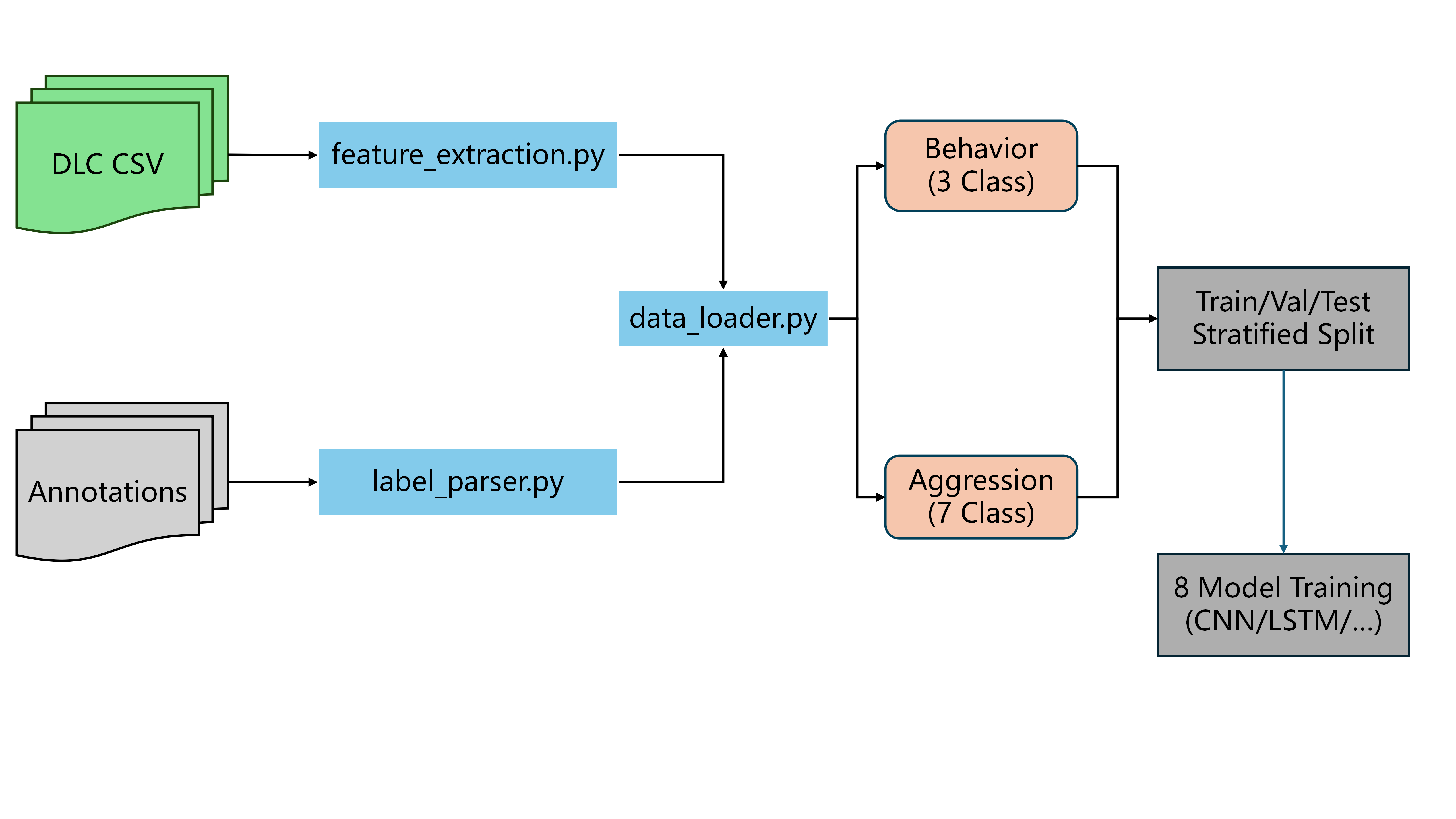
Data pipeline overview

Overview. Raw DeepLabCut pose-tracking CSVs and Caltech Behavior Annotator labels are converted into structured features and aligned labels for two benchmark tasks — coarse-grained 3-class social behavior classification and fine-grained 7-class aggression classification — which are then used to train and compare 8 representative machine learning and deep learning models under a unified, stratified train/val/test protocol.

Abstract

Social interactions are central to behavioral and systems neuroscience, yet progress in understanding their neural basis depends on reliable and scalable behavioral quantification. However, standardized datasets, transparent annotation schemes and reproducible benchmarks for social-behavior classification remain limited. Here, we present a curated video dataset of rat social interactions recorded under the resident-intruder paradigm. The dataset covers non-social, social and aggressive behaviors, with aggression-related episodes further annotated into ethologically defined fine-grained subtypes. To support automated analysis of these dynamic and contact-rich interactions, we provide a reproducible pose-based workflow that converts DeepLabCut-derived body-part trajectories into structured features describing individual movement and inter-animal spatial relationships. Using this feature representation, we benchmark representative traditional machine learning and deep learning models under a unified evaluation protocol. These benchmarks provide reference performance for both coarse-grained social behavioral classification and fine-grained aggression-related behavior recognition, while documenting differences in class-wise performance, training efficiency and model complexity. Together, this dataset and workflow provide an open resource for developing, evaluating and comparing automated methods for rat social-interaction analysis.
Video

Example recordings of rat social interaction under the resident-intruder paradigm, together with DeepLabCut-based multi-animal pose tracking used to derive behavioral features.

Pose Tracking & Keypoint Definition

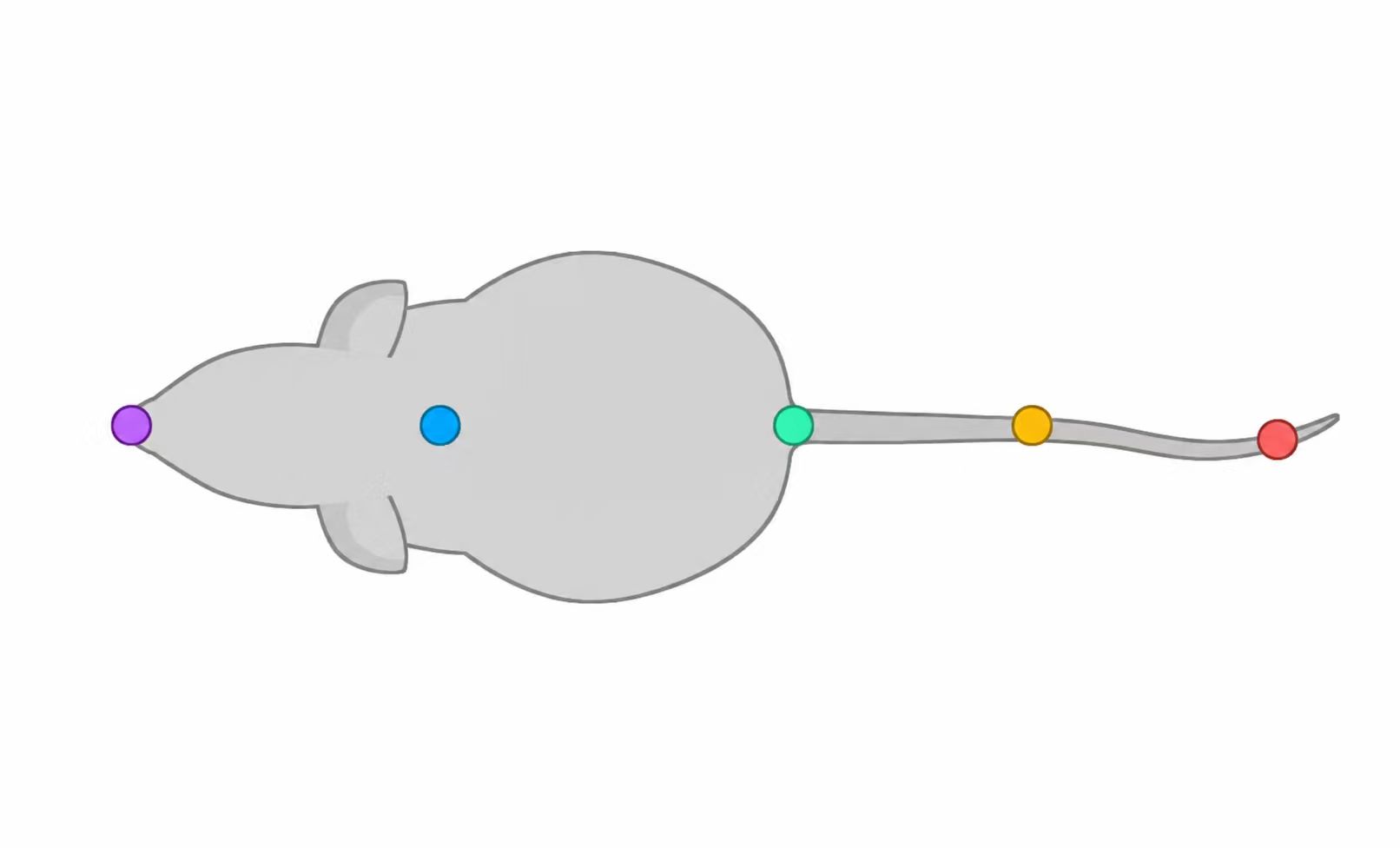
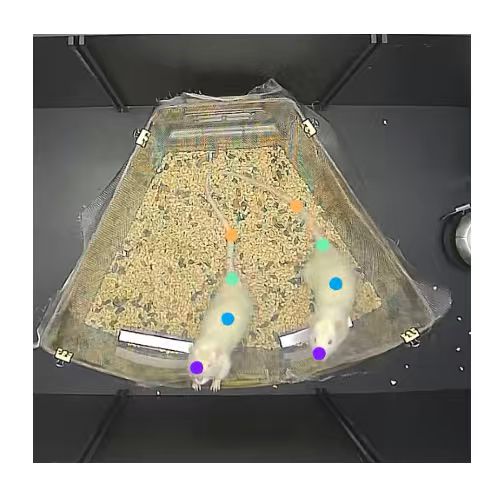
Each rat is tracked with 5 DeepLabCut keypoints — head, body, tail, tail-m and tail-e — under the resident-intruder paradigm. These keypoints are the basis for all speed, distance, angle and coordinate features used in the benchmark.

DLC keypoint definition
Keypoint definition (head · body · tail · tail-m · tail-e)
Multi-animal pose tracking example
Multi-animal tracking under the resident-intruder paradigm

Behavior Labeling Example

Example of frame-level behavior annotation using the Caltech Behavior Annotator, aligned with the tracked keypoints above.

Dataset & Annotation Scheme

Videos are annotated at two levels using the Caltech Behavior Annotator. S1 (behavior level) labels each frame as base, non-social, social or aggression. S2 (aggression level) further decomposes aggressive episodes into seven ethologically defined fine-grained subtypes.

S1 · Social Behavior (3-class)

ClassDescription
AggressionAggressive behavior
SocialSocial behavior
Non-socialNon-social behavior

S2 · Aggression Subtype (7-class)

ClassDescription
Lateral threatLateral threat posture display
Keep downPinning opponent down
ClinchIntense physical grappling
Upright postureUpright confrontation posture
FreezingMotionless state
BiteBiting attack
ChaseChasing opponent

Feature Extraction & Models

26 features extracted directly from DeepLabCut multi-animal tracking (real-time, full pipeline):

  • Speed features (4): individual body-part velocities for both animals
  • Distance features (4): inter- and intra-animal body-part distances
  • Angle features (2): relative orientation angles
  • Coordinate features (12): x, y coordinates of 3 key body parts × 2 animals
  • Interaction features (4): relative angle, speed ratio, approach speed, body speed difference

8 features: a simplified, pre-processed feature set (distance / speed / angle) for rapid experimentation.

Benchmarked models spanning deep learning, ensemble learning, traditional ML and probabilistic models:

MLP LSTM CNN Transformer LightGBM XGBoost Random Forest SVM GMM HMM

Benchmark Results

Under a unified, stratified train/val/test protocol (5 runs with different random seeds, mean ± std), we report accuracy, weighted F1 and macro F1 for all models on both the coarse-grained social behavior task and the fine-grained aggression subtype task. Explore the full interactive comparison — including per-class F1 heatmaps, accuracy ranking, stability analysis and accuracy/F1 trade-off plots — below.

3-Class Social Behavior

Non-social · Social · Aggression

View interactive results

7-Class Aggression Subtype

Lateral threat · Keep down · Clinch · Upright · Freezing · Bite · Chase

View interactive results

BibTeX

@article{chen2026ratbench,
  title   = {A Benchmark Dataset for Rat Social and Aggressive Behavior Classification},
  author  = {Chen, Xutian and Li, Guangyu and Zhang, Zihan and Xu, Mingkun and Wang, Zuoren and Shi, Qianqian},
  journal = {Scientific Data},
  year    = {2026},
  doi     = {10.1038/s41597-026-07888-8}
}